



Retreat of Cliffs
The rocky coast of southern and central NSW has recently been the subject of a review on the origin of its cliffs and associated landforms. In one of the studies a group of us looked at the interaction between erosion of the subaerial or landward cliff and the seaward cliff that constitutes the subaqueous edge (or “drop-off”) of rock platforms. The relevant paper is:
In this study we were able to add to the challenge offered by Tsuguo Sunamura in his 1992 seminal work on rocky coasts on the need for more observations on the seabed just in front of platforms. In this book he cited profile data in a 1978 unpublished thesis by Gillian Reffell from Sydney University. Sunamura noted how little research had been conducted on such underwater landforms. Subsequent studies by others have raised further questions requiring a systemic examination of platform edges, intertidal platforms and subaerial cliffs.
We brought together our own collective scuba diving experiences conducted during the 1970s and 1980s with the work of Reffell (supervised by Andy Short) and another student, Peter Crozier from Macquarie University in 1988. We also looked at factors influencing rock platform development and the broader question of the origin of the rocky continental shelf along this Passive Continental Margin. Specific issues related to erosion of landward and seaward cliffs became a key part of this rocky coast framework as detailed in the above reference. Availability of data from marine LiDAR, recent observations of rock dislodgement, and drone imagery, enabled us to capture aspects of the morphodynamics of rocky sections of the NSW coast. A magnificent drone image of Windang Island taken by John Hudson appears on the front cover of the journal highlighting the interplay of rock type, headland morphology and wave conditions.
I would like to pay tribute to both Reffell and Crosier for their intrepid field work as students. They made numerous surveys off rocky headlands in the northern beaches area of Sydney. Gillian acknowledged Peter Crozier saying he “was extremely generous in his time and energy enduring sea sickness more than once for the sake of bathymetric profiles and a highly successful dive”. In his later thesis Peter thanked John Hudson for his assistance. These were different times; students and staff did not endure the regulatory approval processes for diving and boating that exist today in universities. Our paper was an opportunity to recognise the respective contributions of the students and to record observations we had personally made.
The journal paper documents transects off headlands and cliffed sections of the coast across different rock types. There is clear evidence for detachment of rocks on the seaward edges of rock platforms particularly where rock structures are well jointed. This is termed “wave quarrying”. The level of wave exposure controls the depth of the seaward edge and the degree of movement of dislodged blocks. Many blocks slump seaward and are subjected to continuous abrasion in what Crozier termed the “zone of free movement”, while others are “thrown” onto the rock platform surface. In places they are mobilized into boulder banks. Hence at platform locations exposed to high energy wave action it is clear that their seaward edges are retreating.
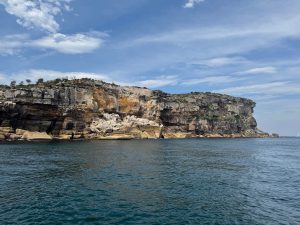
We did not systematically review subaerial cliff retreat of this coast. However, a number of reports are cited which highlight rock falls from cliff faces. An example is shown in the accompanying photo of North Head at the entrance to Sydney Harbour where a collapse occurred in 2016. Such locations are exposed to high energy wave action. Here localised weakened rocks and effects of heavy rainfall and water seepage along bedding planes are further factors in triggering rock fall. This debris can get mixed with blocks detached by waves from the platform edge. Wide-ranging estimates have been given for what is referred to as “long-term cliff recession”. Where the faster rates are occurring it appears that subaerial cliffs are retreating faster than the seaward edge of rock platforms. That suggests that at such places the rock platforms can continue to widen with sea level around its present position ( long Reef is an example).
It also apparent along this coast that subaerial cliffs and seabed features exist which are relics of past sea levels. Unravelling the extent to which rocky coast morphologies carry with them vestiges of higher or lower sea levels, or more exposed wave conditions, remains a challenge. In less exposed locations subaerial cliffs landward of rock platforms may be seen as quite inactive especially where covered by terrestrial vegetation. At one site, Green Point near the entrance to Broken Bay, the former edge of a relic platform formed at a higher sea level (Last Interglacial?) is being eaten away by wave action operating at the back of the contemporary lower level platform. Such an example of inherited topography highlights complexities we face in sorting out what is the “polycyclic history” of this rocky coast.
We hope our efforts in this study has provided a pathway to future studies in understanding the mysteries of this coast.
Bruce Thom (photo of North Head provided by Graham Thom following a scuba dive)
Words by Prof Bruce Thom. Please respect the author’s thoughts and reference appropriately: (c) ACS, 2026. For correspondence about this blog post please email admin@australiancoastalsociety.org.au
#292