



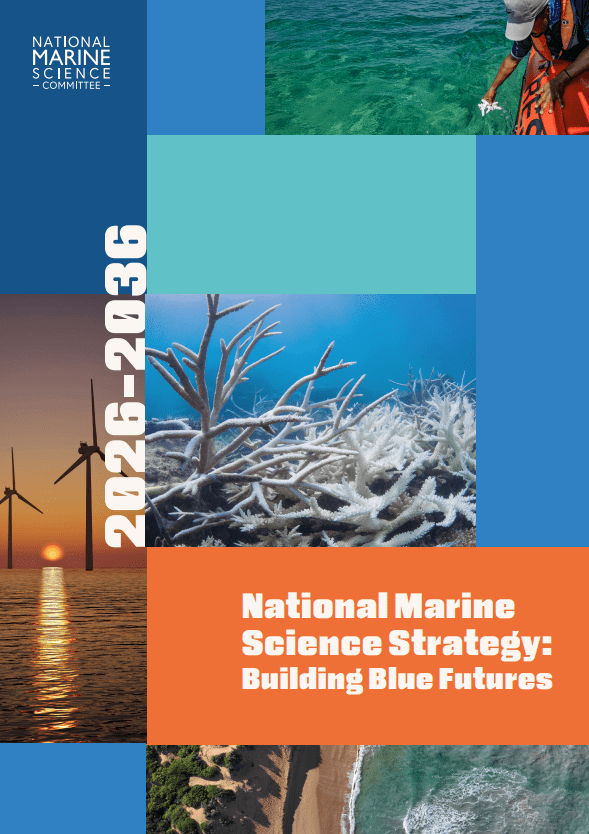
National Marine Science Strategy: Building Blue Futures
On 26th March the National Marine Science Strategy 2026-2036 was launched in Parliament House, Canberra.
The Strategy is available at https://www.marinescience.net.au/national-marine-science-strategy-2026-36/.
This strategy builds on the previous strategy and work by the National Marine Science Committee chaired by John Gunn. Speakers at the launch included Murray Watt, the Minister for the Environment, Tony Haymet, the Australian Chief Scientist, and John. In attendance was a wide cross-section of interests in marine science as well as those from industry, government and non-government organisations. Jo Mummery and I attended on behalf of ACS.
As noted by the speakers, the new Strategy represented a huge collective effort. More than 500 marine scientists and others brought a diversity of knowledge and experience through an extensive consultation process for use by the National Committee in drafting the Strategy. A number of “white papers” were prepared as part of this process. Several ACS members contributed to these papers. They are available at:
https://www.marinescience.net.au/white-papers/.
What impressed Jo and me was the way in which the National Committee brought together such a diverse array of interests around a common objective. This is to secure future research and development that will enable the ocean economy to prosper while at the same time recognising and mitigating impacts from challenges such as climate change and extreme events, biodiversity collapse, and competing ocean uses. It also points to opportunities for sustainable industries and innovation.
One key message from this Strategy, which was emphasised by Minister Watt, is how important is knowledge of our oceans to the future well-being of Australia. As stated in the Foreword to the Strategy: “our ocean drives and regulates our climate, defines our borders, and shapes the cultural identity of our coast-hugging nation”. Moreover, the ocean “is the lifeblood of our trade and a strong driver of our economy”, and “provides our earliest window into future change”. In this context the Strategy offers a pathway for marine scientists to deliver outcomes beyond scientific silos and individual projects. It proposes an approach based on integrated and coordinated programs over the next 10 years involving shared systems and enabling infrastructure.
The Strategy sets out 7 recommendations for national marine science to deliver.
- Recognise, respect and facilitate First Nations knowledge systems to support sustainable sea country.
- Strengthen Australia’s capability to predict climate change and its impacts to support decisions.
- Progress toward net-zero emissions by 2050 through coordinated national climate mitigation.
- Boost coastal resilience through nationally coordinated marine and coastal science.
- Rebuild and maintain marine biodiversity and ecosystem health.
- Fortify maritime security, sovereignty and safety.
- Facilitate a thriving and vibrant blue economy in a healthy ocean.
The National Committee highlighted the challenges we face in in achieving these national ambitions and outcomes. There is a need over the next decade to apply approaches more consistently than in the past and embed them “more deeply in how we plan, invest, collaborate and deliver science”. How all this transpires will involve a collective commitment by the Australian marine science community and an acceptance by the Australian Government, in particular, to appropriately resource those priorities.
Coastal challenges and priorities are considered under two priority areas. They were also discussed in depth in one of the white papers and referred to in others. As one would expect, coastal areas receive a mention in the Strategy section on climate change prediction and impacts. Coastal erosion, flooding, marine heat, coral bleaching, harmful algal are all viewed through a climate change lens. Critically, the behaviour of the Southern Ocean involving interaction with Antarctic ice shelves including impacts on sea levels, demands long-term observations and improved modelling capacity at regional and smaller coastal scales. Relevant to coastal science is the priority to fill gaps in priority observations and baseline data that currently limit detection of change, as well as identification of thresholds, and understanding of cumulative climate impacts (one could add also compound extreme events).
The section on the “Our Dynamic Coastal Zone” embraces the goal that “Government, industry and communities can anticipate and plan for climate-driven coastal change using coordinated, science-based evidence”. The Strategy recognises that without action social, environmental and economic costs will “escalate significantly with losses likely to reach billions of dollars”. Of course this is not new to those of us who worked on the national assessment of climate change risks to coasts in the 2009 and 2011 reports by the former Dept. of Climate Change, and also subsequent studies by state and local governments.
Most importantly, the Strategy emphasises the lack of a national coordinated approach to monitoring, understanding and predicting climate change required “to plan effectively for cumulative and accelerating coastal risks”. Again many will recall we had a National Approach in 2006, but it fell over due to lack of federal government commitment. It is good to see the new arguments for governments of the advantages of such an approach given the challenges the nation faces in coastal areas. As stated “national-scale coastal capability cannot be delivered through fragmented efforts”. The Coastal Infrastructure (CoastRI) program is cited as a critical initiative that needs sustained support.
Three specific coastal science priorities are detailed:
- Establish nationally coordinated coastal observing and modelling systems by modern research vessels.
- Build accessible, national coastal data infrastructure.
- Enable cross-sector collaboration to deliver actionable coastal solutions.
While much of what is in the Strategy is high level and ambitious, it contains insights into what must be done to address long-term nationally significant problems . Of course we can see issues with resourcing and prioritisation. The absence of specific recognition of threats to Australia’s nationally significant urban estuaries is something that was missing. Here is something ACS can work with the National Marine Science Committee to achieve outcomes consistent with the overall goals of the Strategy.
Bruce Thom
Words by Prof Bruce Thom. Please respect the author’s thoughts and reference appropriately: (c) ACS, 2026. For correspondence about this blog post please email admin@australiancoastalsociety.org.au
#291