



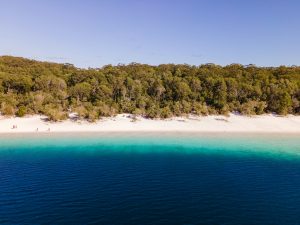
Malcolm Fraser And Fraser Island (K’Gari)
During 2025 several articles appeared in Pearls & Irritations and elsewhere on the role of Malcolm Fraser before, during and after the 1975 “Dismissal” of the Whitlam Government. There is an aspect of this period that involved Fraser as Prime Minister that deserves special recognition. I refer to a decision he drove through Cabinet exactly one year on from that momentous 1975 event. It was a decision that changed the course of history on K’Gari, allowing it to become the World Heritage area that we know today.
Rutile and zircon are two so-called heavy minerals that occur in beach and dune sands along the NSW and southern Queensland coast. They are highly valued for a variety of manufacturing purposes. Australia exported the mineral sands for processing overseas. Following World War 2 sand miners acquired extensive leases moving from the more accessible beach deposits into the lower grade but huge resources that occur in the massive sand dunes. By the late 1960s several companies had their eye on Cooloola high dunes north of Noosa and Fraser Island. At this time mining in Queensland was very much encouraged by the Bjelke-Petersen Government.
A heated campaign by conservationists saved Cooloola in 1970 and it became a National Park as outlined by Michael Gloster in his book “The Shaping of Noosa” (1997). The Premier was not going to let it happen on Fraser Island. The pro-mining State Cabinet commissioned an inter-departmental study that endorsed the extraction of mineral sands on K’Gari. This started what was first a local campaign in the Maryborough Mining Wardens Court. It soon morphed into a political and legal battle embracing the major political parties at a federal level and in the High Court of Australia. Details of this battle to “Save Fraser Island” can be found in books and journal writings of the late John Sinclair (“Fighting for Fraser Island” an autobiography with Peter Norris, 1994; and “Discovering Fraser Island and Cooloola”, 1997).
Sinclair and his team (FIDO, Fraser Island Defenders Organisation) conducted a relentless campaign to raise national awareness on the environmental values of Fraser Island (named after Eliza Fraser who was stranded on the island following a shipwreck in1836) . They had input into the significant review of the nation’s natural assets by Justice Hope chair of the 1973-1974 “Committee of Inquiry into the National Estate”. This was an important early initiative of the Whitlam Government. Sinclair and colleagues lobbied hard to get more action from the federal government using both this Inquiry’s findings and their own observations of impacts of mining that had already commenced. They knew that the Commonwealth had powers to stop the export of unprocessed mineral sands.
Within the Whitlam Government there was division on environmental matters, and as discovered later by Sinclair a high level of duplicity. To some extent the division reflected what existed within the trade union movement with the AWU supporting mining workers and some others looking into the use of “green bans”. By late 1974 Moss Cass as Minister for the Environment secured the passage of the “Environmental Protection (Impact of Proposals ) Act”. However, he could not stop the Prime Minister working with Rex Connor, who had previously shown support to Sinclair, from approving export contracts for minerals extracted from Fraser Island. Following a caucus debate Cass did manage to secure a commitment to hold an environmental inquiry on Fraser Island so an opportunity emerged for anti-mining advocates to develop their case.
The Commission of Inquiry into sand mining on Fraser Island had a chequered history. I served as a witness in 1975 on matters related to sand dune history and got a first-hand view into the machinations of the Bjelke-Petersen Government and mining companies trying to stop it from proceeding. Appeals were made to the High Court but to no avail. By October 1975 the Commission had completed its hearings but it was a full year before it could announce its findings due to legal challenges and events of 11 November.
What followed were first seen as dark days for environmentalists. They knew the Nationals would support the pro-mining agenda of the Queensland Government. In opposition, the Coalition environment spokesman was a National, Ralph Hunt. He saw no reason to stop the mining. The new Prime Minister decided to keep the environment portfolio out of the hands of hostile Nationals, a task made easier in the absence from illness of the leader of the Party, Doug Anthony. A succession of Liberal ministers followed. Andrew Peacock took the portfolio briefly after the election followed by the appointment of Senator Ivor Greenwood. To John Sincliar’s surprise he appeared onside but tragically died of a heart attack before he could be tested. Kevin Newman replaced him and was seen as anything but an ally. Sinclair met him in Maryborough and was subjected to a barrage of criticism. He noted: “My motives were questioned; FIDO was accused of publishing untruths; FIDO was branded as an organisation dedicated to subverting the proper workings of government and Mr Newman declared that everything we said and did put him ‘into the other camp’”.
When the final Report of the Environmental Inquiry was released on 26 October 1976, Minister Newnam stated that the Government would give it “full and careful consideration” indicating he was sympathetic to Fraser Island being part of the National Estate. However, the report was savagely attacked by some elements of the press, the miners, many in the local community, and of course the Queensland Government. Environmental groups were not optimistic that the Fraser Government would endorse the Report’s recommendations especially given the antagonism of coalition partners. They underestimated the conservation interests of the Prime Minister.
Malcolm Fraser was known to have a soft touch for environmental matters. He had been one of the first councilors on the Australian Conservation Foundation when it was formed in 1966. John Sinclair had been sending him photos and reports over several years so he was made aware of the damage being inflicted by initial mining efforts. Still it came as a shock when on the 11 November 1976, one year on from the “Dismissal”, that one of the most important environmental announcements in Australian environmental history was made . Cabinet endorsed the recommendations of the Inquiry and so did the Labor Party. This was not what the Bjelke-Petersen Government wanted.
Malcolm Fraser made a call in the public interest. A very precious part of the National Estate was deemed to be of such national importance for the Commonwealth Government to override commercial and community benefits that many wanted to secure. It was clearly a “brave decision”. His direct intervention provided the legal mechanism that stopped the mineral exploitation of K’Gari paving the way for it to achieve World Heritage status. What would it have looked like if the decision had gone the other way?
Bruce Thom
Words by Prof Bruce Thom. Please respect the author’s thoughts and reference appropriately: (c) ACS, 2026. For correspondence about this blog post please email admin@australiancoastalsociety.org.au
#289